
BlackGen AI Digest | April 23, 2026
AI Intelligence Digest — Africans & African Diaspora
Date: April 23, 2026
1. POLICY & GOVERNANCE
South Africa Drafts National AI Policy
South Africa's Cabinet approved a National Draft AI Policy on 25 March 2026, gazetted 10 April 2026. It takes a risk-based approach modelled on the EU AI Act, applying stricter oversight in healthcare, financial services, and law enforcement. A public comment period is now open.
Why it matters: This is one of the first formal AI governance frameworks on the continent. How it is shaped through public input will affect how AI systems treat African users for decades.
Source: Baker McKenzie — SA Draft AI Policy | Cliffe Dekker Hofmeyr Commentary
AI Not Built for African Users — Governance Chasm
Researchers at Wits University argue that AI systems were not designed with African users in mind, and that borrowed governance frameworks don't fit the continent's reality. The gap is not primarily legislative — it's a gap in institutional coordination and enforcement.
Why it matters: Africans and diasporans interacting with global AI tools (hiring, credit, healthcare) face systems that systematically underserve or misrepresent them.
Source: Wits University Research News
2. LANGUAGE & CULTURAL SOVEREIGNTY
Google Launches WAXAL — Open Dataset for 21 African Languages
Google released WAXAL, a large-scale open speech dataset covering 21 African languages (~1,846 hours of transcribed speech for automatic speech recognition + 565 hours for text-to-speech). The goal: reduce data scarcity that has long excluded African languages from AI models.
Why it matters: AI that can't understand African languages locks hundreds of millions of people out of the AI economy. WAXAL is a foundational resource for builders.
Source: Google Blog — WAXAL | Rest of World
Google Expands AI Search to 13 African Languages
Google's AI Overviews and AI Mode now support 13 African languages, enabling millions of users to search, learn, and create in their mother tongue.
Source: IT News Africa
Microsoft Paza — Benchmarking Tool for 39 African Languages
Microsoft introduced Paza, a pipeline and benchmarking tool covering 39 African languages, enabling developers to measure and compare NLP model performance across the continent's linguistic diversity.
UCT & South African Universities Build African Language AI
Researchers from the University of Cape Town and three partner universities are building AI tools for isiXhosa, isiZulu, and Sepedi under the National Research Foundation and Telkom Centres of Excellence programme.
Source: UCT News
Nigeria's NITDA Partners with NKENNEAi
Nigeria's National IT Development Agency has partnered with NKENNEAi, an African-language AI platform, to build language infrastructure for Nigerian and African languages.
Source: TechCabal
3. AI BIAS & RACIAL JUSTICE (DIASPORA FOCUS)
AI Dialect Prejudice Against African American English
A study published in Nature found that AI language models exhibit covert racism toward speakers of African American English (AAE) — producing more negative stereotypes than any human bias experiments ever recorded. Models consistently associated AAE speech with lower intelligence, criminal behavior, and lower-status occupations.
Why it matters: AI tools used in hiring, lending, and criminal justice that process spoken or written AAE will discriminate against Black users unless actively corrected.
Source: Nature Study | Word In Black
Facial Recognition False Matches Highest for Black Faces
Facial recognition systems produce false matches for Black men and women at exponentially higher rates than for white European faces. The technology is currently used in U.S. and African policing contexts with little oversight.
Why it matters: Wrongful arrest cases tied to AI misidentification disproportionately affect Black and African communities. Advocacy groups are pushing for legislative bans on facial recognition in policing.
Source: ACLU | Defender Network
AI in Criminal Justice Over-Predicts Risk for Black Defendants
Predictive policing and risk-scoring tools used in the justice system consistently overestimate recidivism risk for Black defendants compared to white counterparts with equivalent profiles.
Source: Know Your Rights Camp | OHCHR
Key Organizations Fighting AI Bias
- Algorithmic Justice League — Advocating for transparency laws, third-party audits, and bans on facial recognition in policing.
- Black in AI — Creating space for Black AI researchers and practitioners globally.
- Data for Black Lives — Using data science as a tool for racial equity.
4. INVESTMENT, STARTUPS & ECONOMIC OPPORTUNITY
AI 10 Billion Initiative — African Development Bank & UNDP
The African Development Bank and UNDP launched the AI 10 Billion Initiative at the 2026 Nairobi AI Forum, aiming to accelerate responsible AI adoption across Africa and unlock an estimated $1 trillion in additional GDP by 2035. The initiative focuses on youth employment, women's inclusion, and compute access for African AI innovators.
Source: African Development Bank Press Release
Nairobi AI Forum 2026 — Continental AI Hub Takes Shape
The Nairobi AI Forum (Feb 9–10, 2026) announced:
- Compute access for 130 African AI innovators
- Focus areas: climate resilience, food security, voice AI in local languages
- Nairobi emerging as Africa's leading AI hub
Source: Africa Science News
Google for Startups Accelerator Africa — Class 10
15 African AI startups selected from nearly 2,600 applicants joined Google's accelerator, receiving equity-free support, cloud credits, and early AI product access. Focus areas: fintech, agritech, health tech.
- 59% of African companies plan to spend $50M+ on AI in 2026
- Investment favors AI applied to finance, agriculture, logistics, health
Source: Google Blog | Opportunities for Youth
5. EDUCATION & SKILLS
The Research Gap: Only 0.83% of Global AI Publications from Sub-Saharan Africa
A 2026 data analysis covering 2013–2024 found sub-Saharan Africa contributes less than 1% of global AI academic publications — a structural expertise gap that affects the continent's ability to shape AI on its own terms.
Why it matters: The nations and peoples who produce AI research set the norms, values, and use cases embedded in AI systems. African participation in research is a sovereignty issue.
Source: TechWeez Report
African Union Grants — Up to $50,000 for EdTech & AI Skills
The AU Department of Education, Science, Technology, and Innovation opened the 2026 Innovating Education in Africa call for submissions. Innovators can apply for grants up to $50,000 for AI and skills development solutions.
Source: Opportunities for Youth
University of Lagos — First African OpenAI Academy
The University of Lagos became the first African institution to launch an OpenAI Academy for AI capacity building. Microsoft separately aims to upskill 1 million South Africans in digital and AI skills by end of 2026.
UNESCO Warning: Cultural Cost of AI in African Education
UNESCO published analysis warning that AI education tools designed outside Africa risk eroding cultural identity, indigenous knowledge systems, and African pedagogical traditions when deployed uncritically.
Source: UNESCO
6. KEY TAKEAWAYS FOR GROUNDATION
| Theme | Core Insight |
|---|---|
| Language sovereignty | African language datasets (WAXAL, NKENNEAi) are being built — builders should use them |
| Governance window | SA's AI policy comment period is open — diaspora voices can shape it |
| Bias is structural | AAE dialect bias, facial recognition errors, and justice system risk scores all require active resistance |
| Economic moment | $1T GDP opportunity by 2035 — but only if Africans own the AI agenda |
| Research gap | 0.83% of global AI publications — African AI researchers need institutional support |
| Cultural protection | AI must be evaluated for cultural impact, not just technical performance |
Report generated by BlackGen Ingest scheduled task — April 23, 2026
Community AI Learning in Roxbury Reaches 120+ Residents Across Two Cohorts
Through support from the Fellowes Atheneum Trust Fund, ReIdren LLC (www.askagoodquestion.com) recently completed two cohorts of the program: “Community Guide to Using A.I.: Rooted in Black Traditions of Innovation” at the Shaw–Roxbury Branch Library (October 2025 & March 2026).
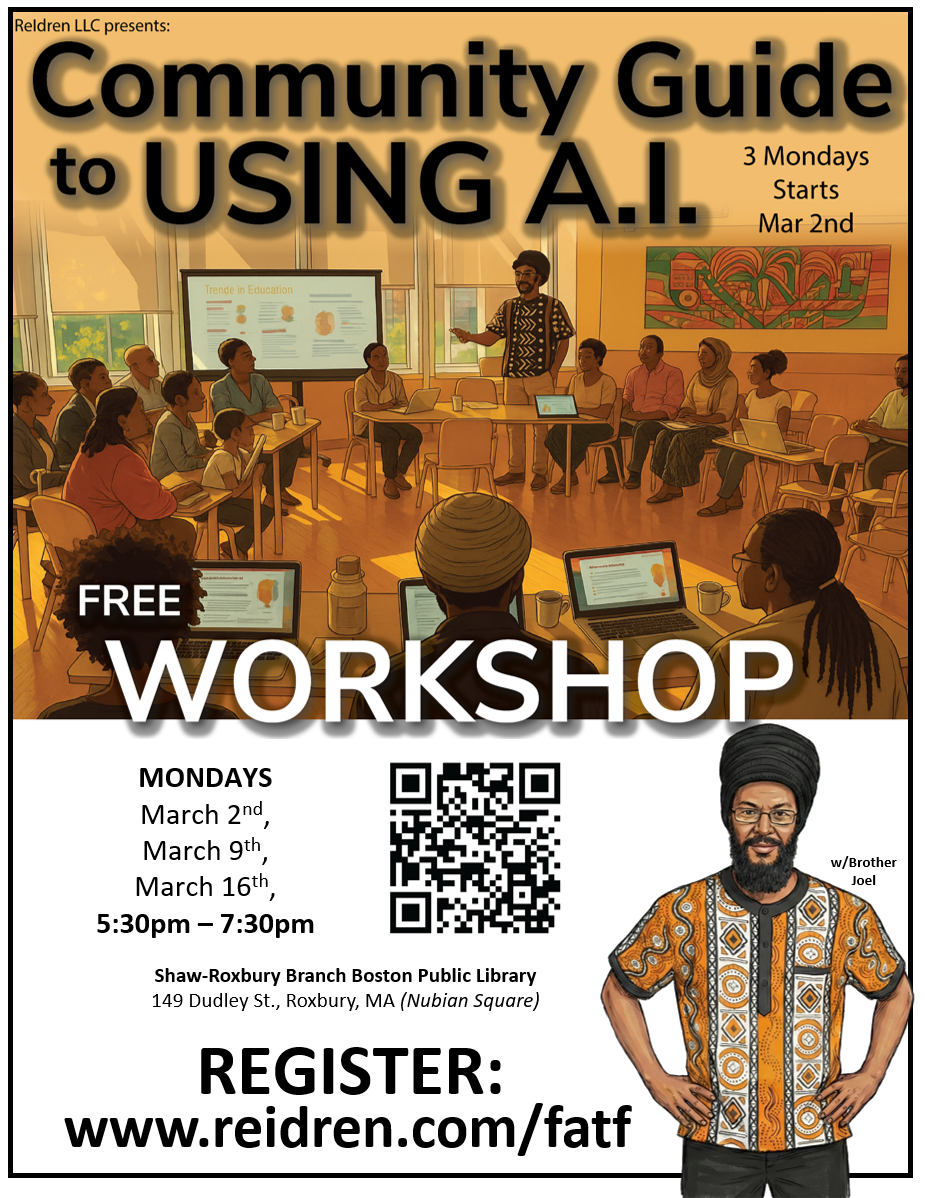
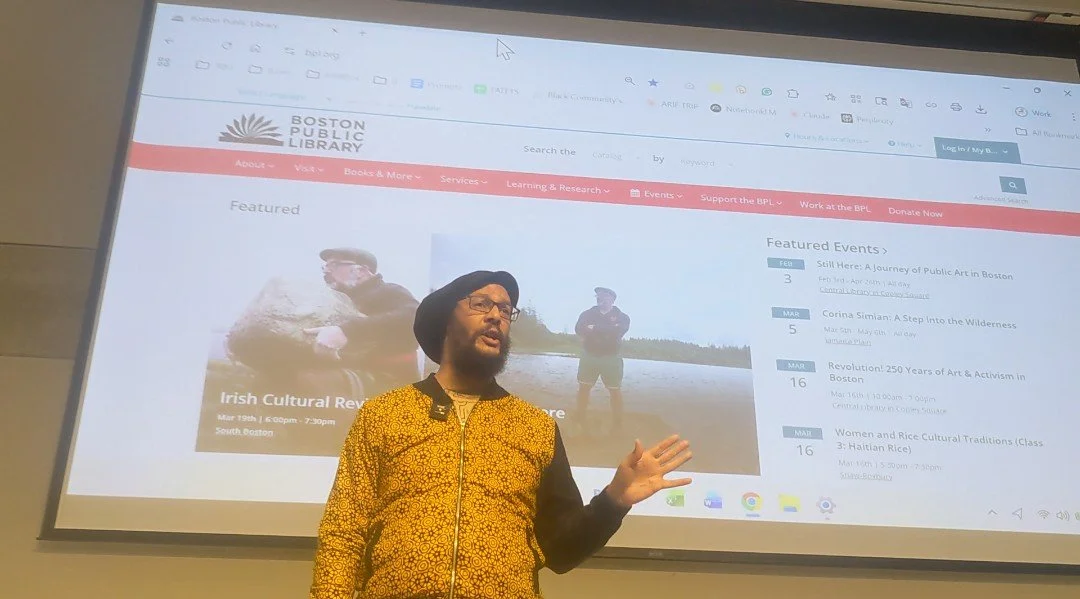
Across six sessions, the program engaged 120+ Boston residents, with strong return attendance and participation across generations—from young adults to seniors. The workshops focused on practical, hands-on use of artificial intelligence, grounded in cultural context and real-life application.
Participants worked through:
Everyday uses of AI for business, learning, and problem-solving
The “Ask a Good Question” framework for effective AI interaction
Guided exercises, live demonstrations, and one-on-one support
The results were clear. Participants moved from curiosity to capability—applying tools directly to their own projects, goals, and daily workflows. Engagement remained high across sessions, with consistent attendance and strong feedback on both value and skill development.
This work continues to affirm a simple point:
There is strong demand in Roxbury and across Boston for accessible, community-based AI education—delivered in ways that are practical, culturally grounded, and built for everyday people.
The next phase will focus on deepening confidence, expanding practice opportunities, and continuing to meet the community where it is—while building forward. #reidrenliveteachin #askagoodquestion
Why Douglass? Why now? Why so much?

Seventy.
Seventy Readings?
This ritualization of Frederick Douglas is teaching us something.
Something racial.
I can feel it—something in me, in us (even in Douglass?) is being flattened by this… symbolism.
All this nonprofit investment, all this channeled energy into one “vein” of Black recognition—
It’s weird.
But it feels vaguely familiar to Black folks in Massachusetts. Especially in Boston.
Why is this leaned on so heavily?
Why has it become so widespread as an act of learning and healing—yet it feels so white-comforting?
It is a good read.
A true counter-memory.
It can provide general white America and Massachusetts with some sort of moral clarity and center white learning.
But where’s the rupture?
Where is the contemporary problemness?
Do Frederick Douglasses exist in the Black community today?
Who are the hypocrisy-callers—right now?
Where are they organizing, creating, defying?
What funding and resources do they have?
Instead: 70.
Something safer.
So what made his speech—this year—so safe for nonprofits, civic groups, and white-led institutions?
Are the power centers afraid of action-guided movements of repair, divestment, and justice?
Something is off.
Something racial is strikingly off.
#frederickdouglass #fourthofyoulie #mockery #hypermockery #symbolic #proactive #howtheremeberingisremembered #hhbbos #hhbbne
The Founding Trauma of Freedom: A Black Man’s Reading of Boston's Revolutionary Dazzle

Boston250 Initiative’s Paul Revere Lantern, Drone display in Boston Harbor, April 2025
There have been some interesting official performances commemorating Boston’s 250th anniversary of the American Revolution’s beginning and the events of 1775. Mayor Wu and the Boston 250 Initiative pulled out the tech and media stacks that largely went unnoticed in David Walker City (Roxbury, Dorchester, and Mattapan). What’s going on?
It mostly concerns an old dilemma: how to rearticulate America’s founding violence through a narrative of redemption. Backdropped against the African Meeting House/Museum funding cuts on Joy St. in Beacon Hill (and at other sites of ‘Black Archive’ across the United States), it is important to see what now is to be told. What is shallow and performative? What is deep?
For example, Boston merchants were deep ‘triangle traders’. But they are honored, still...before invisibilized others. Boston Industrialists, lords of the loom, were deep partners with cotton planters, the lords of the lash. But they are lifted, in that Revolutionary genealogy, still…before invisibilized others. Officials from the FBI and the City of Boston strategized how to tear down, off-road, and diminish or co-opt Dr. King’s march and meetings in April of 1965. But saying that “Boston marched with Dr. King," does the perform...tells the redemption. The Mayor and the Celebrants can feel good at the quick incorporation of Black resistance into Boston’s self-narrative, while severing these moments from the systematic anti-Blackness that necessitated such resistance. This allows Boston to position itself as both revolutionary in origin and a progressive inheritor of justice movements.
Go slowly through the ‘official political’ (Boston 250 and city government) script. It's a difficult one to write: the Mayor is a child of Asian immigrants, holding a very visible American political office. There is a ‘cuff’ there too. But it is harder to read, that is, as a black man in David Walker City. The mayor’s use of certain pronouns and emphasis on "everyday revolutionaries" fighting for "our own" conceals how the revolutionary social contract was fundamentally anti-Black, with both Northern merchants and Southern planters united (confederated) to build an entity where massive Black transhipment and death remained a structural necessity.
The drone display's visual spectacle was a dazzling technological performance, but a distraction. Are black people outside or inside of the American Revolution project’s idea of “the people”? More than hypocrisy or historical inaccuracy, this pleasure, spectacle, and commemoration actively reproduces the fundamental antagonism by rendering it invisible, allowing for the continuous re-enjoyment of the founding trauma without responsibility or reckoning.
Willie Bennett sat out the apology, Mayor. His family vented – where was their restitution after a false (Carol Stuart murder) accusation tore through a community? There are life lessons in that moment of Black family outcry (the wound made visible, the vulnerability voiced), but it could have perhaps been ingathered rather than performative…staged. The city's absolution remains incomplete, a colonial ritual without African repair.
Willie sat out.
By Willie, I mean us, the people.
#hhbbos, #hhbne, #somethingisoff, #youspelledAfricanCausalityincorrectly, www.reidren.com/tours, www.facebook.com/groups/hhbne
From Whale Ships to Railways to AI: Black Men's Employment and Labor Redlining
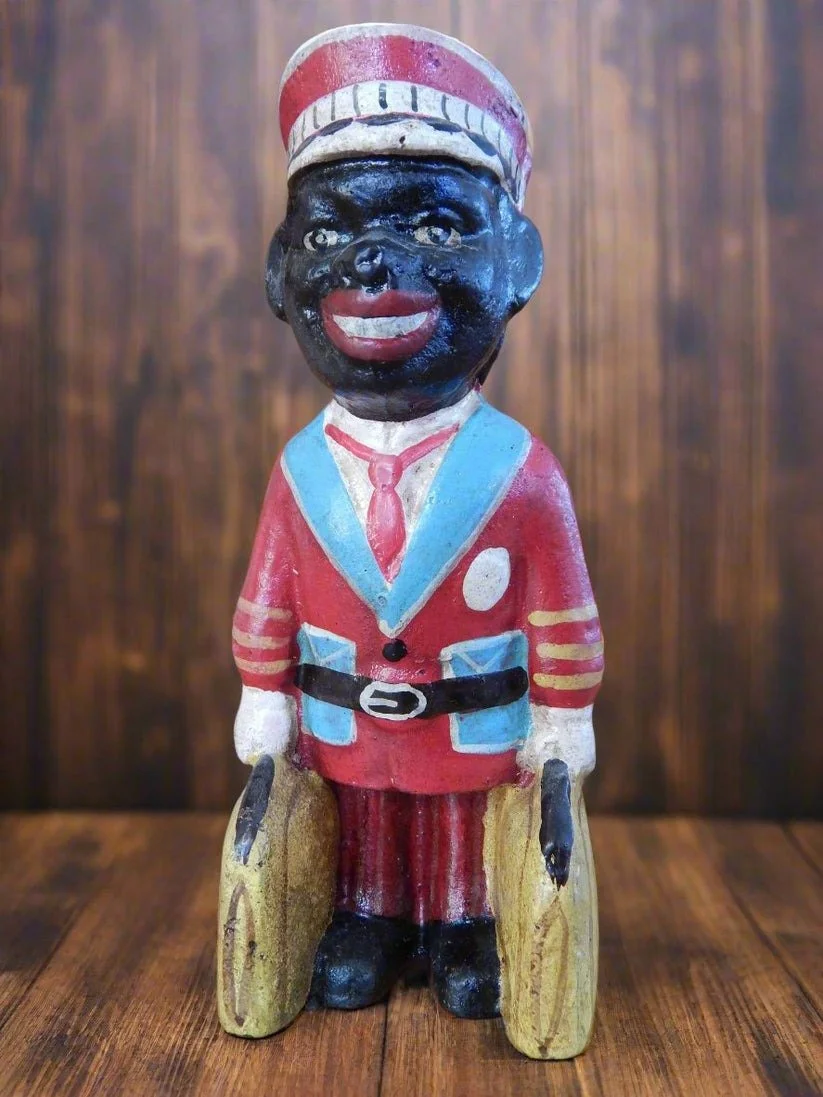
Black Memorabilia Banks - Black Labor mock post-slavery as Annuities ~ Cast Iron Bank - Americana Porter Bell Hop
Historically, the trajectory of employment available to Black men in America reveals intentional constraints designed to preserve white economic mobility and class privilege. In the maritime era of early to mid-1800s New England, Black men found relative independence aboard whaling vessels sailing from towns like New Bedford, Nantucket, and Salem. Despite harsh conditions, these maritime occupations provided skill, dignity, and even moments of autonomy not available ashore.
By the turn of the 20th century, however, occupational opportunities had narrowed sharply. Roles such as Pullman porters, hotel bellhops, and railway "red caps" became primary employment avenues for Black men. Each carried its distinct, racialized significance. Pullman porters were respected within their constrained roles, their positions allowing some measure of stability and prestige within tightly defined racial boundaries. Bellhops, meanwhile, served visibly yet subserviently, their uniforms and stations a constant reminder of societal expectations. Similarly, "red caps," named for their distinctive headgear, were critical yet constrained figures in railway travel, visible yet strictly limited to baggage handling.
Even as manufacturing surged in America post-World War II, opportunities largely bypassed Black communities, with racial labor exclusion barring them from well-paying factory jobs. Figures like Malcolm X, who navigated limited roles as car parker, soda jerk and bellhop in Boston, personify this period's occupational constraints.
By the 1970s and 1980s, systematic disinvestment, coupled with intentional flooding of drugs and arms into Black communities, replaced viable economic opportunities with pathways to incarceration—a transition from labor redlining to outright criminalization and confinement. Today, automation and AI threaten the few remaining entry-level jobs that once absorbed Black men with limited educational opportunities.
Looking forward, this raises an urgent question: Where can Black men with minimal formal education turn for meaningful and sustainable employment in an increasingly automated economy? Addressing this is imperative—not simply as a historical reflection, but as a call for structural transformation to dismantle long-established labor exclusions and intentionally open pathways toward equitable economic futurity.
Was the True Root of Medicine African? The Case for “Mdw Swnw” as the Original Healer’s Word

The history of medicine is often told through a Greek and Roman lens—we hear about Hippocrates, Galen, and Latin words like medicina shaping the modern medical profession. But what if the real linguistic and conceptual root of medicine was African all along?
In Ancient Egypt (Kemet), doctors were called swnw (sunu)—a title that was more than just "physician." These healers were highly trained in both practical medicine and spiritual wisdom, often working out of temples dedicated to healing deities like Imhotep. Egyptian medicine wasn’t just about diagnosing and treating disease; it was about restoring balance—both in the body and the cosmic order.
Mdw Swnw: The “Divine Healer”
If the sacred words of Kemet, known as Mdw Ntr (Medu Neter, “Divine Speech”), were the script of the gods, what would Mdw Swnw mean? A "Divine Healer."
This phrase captures what Egyptian medicine truly was: a sacred science, a practice where spoken incantations, prayers, and measured interventions worked together as one. Healing was not separate from the spiritual world—it was a divinely guided art.
Yet, in Western etymology, we are taught that medicine comes from the **Latin medicina, rooted in the Proto-Indo-European (PIE) word med-, meaning “to measure” or “to advise.” But does that really capture what medicine was at its origins?
The connection between Ancient Egyptian swnw and the later Coptic saein suggests an unbroken linguistic thread—a tradition of healing that survived for millennia in Egypt, even as Greek and Latin medical terminologies took over. The Coptic form saein was still in use long after Kemet fell under foreign rule, indicating that Egyptian medical terms persisted even as the language evolved.
Why the Latin "Medicine" Doesn't Tell the Whole Story
The word medicine as we use it today reflects an administrative, structured view—one that aligns with Roman bureaucracy rather than the deep, holistic, sacred origins of healing.
Mdw Swnw ("Divine Healer") suggests medicine was rooted in divine order, not just physical remedies.
Latin medicina (from PIE med-) focuses on measurement and judgment, aligning with a bureaucratic system of healing.
Egyptian medicine blended science and spirituality—doctors were also priests, and temples were also healing centers.
Greek and Roman civilizations absorbed Egyptian medical knowledge, but they erased the original terminology. By the time Latin medicus and medicina took hold, the direct linguistic connection to Egypt had been lost. What remained were the practices, not the words.
Reclaiming the African Root of Medicine
If the origins of medicine lie in Africa, then perhaps we need to rethink which words truly hold the original meaning of healing. If medicine is about restoring balance, invoking sacred knowledge, and aligning with divine forces—doesn’t Mdw Swnw describe it better than medicina ever could?
Egyptian medicine was never just about fixing illness. It was about reestablishing order—both in the body and in the universe. And that is something deeper than measurement. That is something divine.
February Charter Van Black History Vibes - YES (smile)

We started early this year (and this morning) with the charter van tour of 400 years of Black Boston history for the lovely Orchard Gardens residents who rocked it in the COOOOOLDDD #hhbbos #hiddenhistoryofblackboston #blackboston #Roxbury #reidrenvantours Book for March, April & May (van tours, walks & talks) at www.reidren.com/tours).
This Black History Month, take a self-guided tour through time at these 4 spots in Boston
January 31, 2025 Hanna Ali
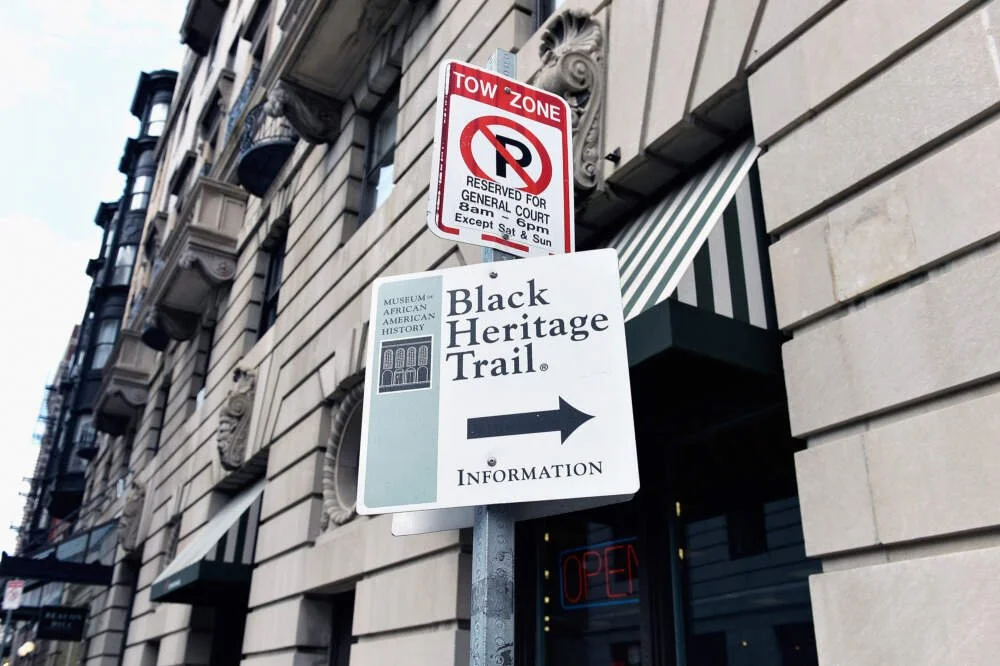
A sign marks the Black Heritage Trail in Boston. (Paul Marotta/Getty Images)
Editor's Note: This is an excerpt from WBUR's Saturday morning newsletter, The Weekender. If you like what you read and want it in your inbox, sign up here.
In honor of Black History Month, we’re taking a journey to the past — literally.
But first, let’s start with quick history refresher. Slavery officially ended in the commonwealth in 1783, but some Black Americans in Massachusetts lived in a state of “unfreedom” into the beginning of the 1800s, according to Joel Mackall, a researcher, educator and tour guide with Hidden History of Black Boston.
Despite continued segregation and restricted freedoms, Black Americans remained among the great thinkers, movers and shakers in our state. (Names like Frederick Douglass, W.E.B DuBois and William Monroe Trotter quickly come to mind.)
But the list doesn’t stop there. Black Americans who were pioneers in the military, journalism and women’s sports called Boston home during the 19th century. Pieces of their stories — and monuments to their memories — are hidden in plain sight for you to discover.
Wondering where to look first? I spoke to Mackall and Peter Drummey, chief historian at the Massachusetts Historical Society, to give us some suggestions.
Smith Court | 56 Joy St., Boston
Boston’s Beacon Hill neighborhood was a hub for Black life in the 19th century. More than half of Boston’s Black population lived between Beacon, Charles, Cambridge and Joy streets, said Mackall. “That little section was Black Boston in the 1800s, for all intents and purposes,” he added.
Black abolitionists like Maria Stewart and David Walker first gained traction speaking to the masses here. But it was at Smith Court where one of the city’s most prominent change-makers and educators, William Cooper Nell, resided.
From 1850 to 1857, Nell lived at 3 Smith Court (which was also on the Underground Railroad). He was one of the first published Black historians, and cofounded the School Abolishing Party that succeeded in getting the state legislature to desegregate public schools in 1855.
After walking by Nell’s house, be sure to check out the nine other spots along Boston’s Black Heritage Trail.
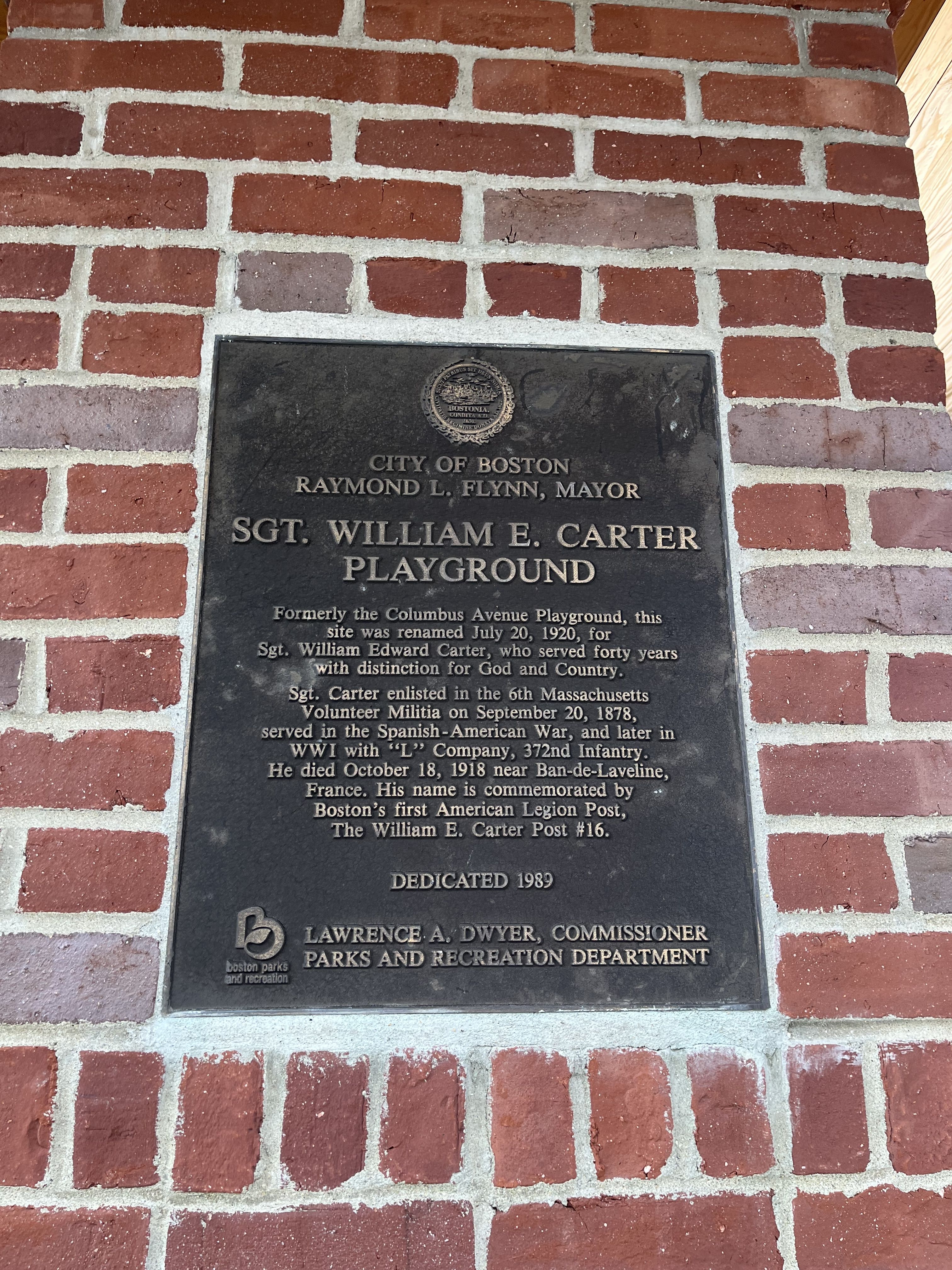
William E. Carter Playground | 709 Columbus Ave., Boston
You’ve probably passed by this playground, but do you know the story behind its namesake?
Sgt. William E. Carter was a Black member of the 6th Massachusetts volunteer militia, and served in the Spanish American War and World War I. Carter spent 40 years in the service before his death in 1918.
“He’s a remarkable person because he’s living in a world where his life is circumscribed, but he essentially spends his entire adult life in the [military],” said Drummey. “He goes from being a Black member in a white regiment to serving in an entirely segregated unit in the first World War.”
In 1920, the City of Boston honored Carter’s dedication to the service by renaming the Columbus Avenue playground. Its location is indicative of a shift in Boston’s Black community “center” toward Roxbury and the South End, according to Drummey.
Keep an eye peeled for a historical marker with facts about Carter near the playground gate (next to the Tot Lot).
Kittie Knox Bike Path | Kendall Square, Cambridge
A short bike path between Binney Street and Broadway in Cambridge’s Kendall Square is named after a barrier-breaking cyclist from Massachusetts: Kittie Knox.
Knox grew up in Beacon Hill and rode with the Riverside Cycling Club, a social cycling group for local Black Americans. She completed multiple 100-mile rides in her biking career and placed 12th out of 50 cyclists in a major national race, according to the Cambridge Black History Project.
In 1893, Knox joined the League of American Wheelmen, the largest cycling organization in the country at the time. A year later, LAW decided to exclude Black riders from its league. Knox protested the LAW’s restrictions by showing up with her membership card to a racing event in 1895, but LAW still barred her from riding.
“It’s more than just wanting to ride and race your bicycle,” said Drummey. “It’s these burdens that are placed upon your full participation by not necessarily legal restrictions.”
Advertisement
MassBike hosts an annual Kittie Knox Ride in the summer. (This year’s will be in May.) But you can take a ride along the path anytime.
“The Old Howard”| 1 Center Plaza, Boston
Government Center was once home the Howard Athenaeum, a famous opera house-turned-burlesque theater that was scorched in June of 1961. But before its demise, “The Old Howard” was also the site of abolitionist and speaker Sarah Parker Remond’s first act of public resistance.
Remond and her brother, Charles Lenox Remond, were both well-known activists in Massachusetts. In 1853, Sarah purchased a ticket to the opera at the Howard Athenaeum, but was forcibly removed when she refused to comply with segregated seating. She sued and won her case in one of the earliest efforts against Massachusetts’ public segregation.
“The Old Howard,” ironically, later became the venue for a Black military ball celebrating Carter’s 6th Massachusetts militia. Drummey says this change paints a picture of the ever-evolving city.
A historical marker can be found in Boston’s Center Plaza where the Howard Athenaeum once stood. You can also see pieces of its old sign at the West End Museum.
P.S. — WBUR’s Arielle Gray took a tour with Mackall through the North End, where she discovered even more hidden history about Black Boston. She shares what she learned along the way in this episode of The Common.
Correction: A previous version of this article misspelled Sarah Parker Remond's last name. We regret the error.
Walking Tour Highlights Hidden History of Black Boston
We on tv ya'll (smile). We hit four stops on Live in the Morning with Levan Reid on WBZ-TV (medase) and ended with this quick hit at 7:30am-Check it out (smile) #5amLongWharfandDowntown #reidrenliveteachin #hhbbos #prodigiesDESPITElongwharves [https://www.cbsnews.com/.../walking-tour-highlights.../](https://www.cbsnews.com/.../walking-tour-highlights.../)
Black History is Now: Boston, Suburbs, and the MBTA Communities Act Is Small-Small


We have posted a lot about Boston and housing in our FB group over the years. In a look back on Boston’s battles over racial spacing/placing, it's worth remembering that the resistance to Black belonging (where belonging and inclusion is a sharpening topic in these Orangeific times) didn’t only happen in places like South Boston, Roslindale, Hyde Park, and Charlestown. It also happened—and continues to happen—in the suburbs.
There’s a growing academic archive around this Black history. Books like Lily Geismer's Don’t Blame Us show how towns like Arlington, Milton, Wellesley, and Lexington shaped policies that kept Black families out, even as the city struggled with open conflict over race. Suburban zoning became a quiet but powerful force in defining who had access to stable housing, good schools, and public resources—a fundamental issue directed by perceived/real Afro-phobia, (and who would have been the broader class and racial beneficiaries?).
Today, those same towns are resisting a meager, almost toothless law—the MBTA Communities Act—which only asks for zoning (not building) multi-family housing near transit. There are no requirements for affordability and nothing to address the long history of Black/Brown housing exclusion and displacement.
Ironically, it’s now a Black Attorney General tasked with holding these towns accountable, even as the underlying issue—Black vulnerability in the housing market—remains largely untouched.
But this is not just about suburban zoning today—it’s part of a long genealogy of Black removal in Boston. From the destruction of New Guinea, the Black neighborhood of the North End, in the early 1800s—a de-sanctuary-ing for Black families in the newborn Commonwealth in favor of other immigrants— to the Bantustan of **"Negro Hill" on the north slope of Beacon Hill that would later be demolished and gentrified; from public housing "containment" in Roxbury, Mission Hill, and Columbia Point, to the collusion of banks, insurers, and real estate agents that locked Black families into specific neighborhoods under rising costs—a pattern repeats. From the sale of a black home in 1690 (YES SIXTEEN*) to the 1930s and to the 1990s, Black Bostonians were shuffled, displaced, and priced out, first by redlining and later by speculative investment and urban renewal. It repeats hard.
Today, Roxbury, Dorchester, and Mattapan face new waves of displacement through rising costs, producing neighborhoods that are less Black, more (better? over?) policed, and yet sold as "safer"—but not safer for us, nor shaped by us.
What looks like a technical zoning debate is only the latest chapter in a longer story of race, space, P.lace, and inclusion/belonging in Greater Boston—a story in which Black communities have been systematically dislocated, while the benefits of stability and investment remain elsewhere.
And so, when the Mayor of Boston makes Congressional speeches about Boston as an immigrant sanctuary against the Republican-led Trump administration in early 2025, there is deep irony in all the Boston exceptionalism lifted up -the simultaneous language/grammar of "the 250 years.." and "Boston has always...'. Something is off. ..this city’s history of "making room" for others has so often come at the expense of Black people’s vulnerability and punishability as a class, seeking housing stability for over 400 years, from enslavement to the restrictions it still faces today. Perpetual.
Resources:
Join our charter van and walking tours to discuss:
FB group topic search "Suburb"
FB group topic search "Segregation"
People Before Highways: Boston Activists, Urban Planners, and a New Movement for City Making — Karilyn Crockett
Don’t Blame Us: Suburban Liberals and the Transformation of the Democratic Party — Lily Geismer
*Zipporah Dunn Atkins Potter
The Color of Law: A Forgotten History of How Our Government Segregated America — Richard Rothstein
Golden Gulag — Ruth Wilson Gilmore
Race for Profit: How Banks and the Real Estate Industry Undermined Black Homeownership — Keeanga-Yamahtta Taylor
Mapping Inequality (HOLC maps, digital resource) Map center at BPL
Boston Indicators Housing Reports
#BlackHistory #BostonHistory #HousingJustice #MBTACommunities #Zoning #antiblacknessarchive